Vitamin E: Chemistry & Useful Facts
Written by:
Dr. Nicole Vita, Centerline Equine Nutrition & Dr. Rachel Mottet, Legacy Equine Nutrition
Vitamin E is a “reactive” compound due to its properties as a potent antioxidant. A reactive compound refers to one that acts as an electron donor to neutralize free radicals in the body, thereby functioning as an antioxidant.
Before getting into the thick of it, let’s first briefly distinguish electrons and free radicals. Think of electrons as the beams that support a house. The atoms that make up a molecule—carbon, hydrogen, oxygen, and others—are like rooms, and the electrons are the structural beams holding everything together. Free radicals are like a house that is missing a beam, unstable and desperately trying to steal one from a neighboring structure.
Free radicals exist in the horse’s body naturally due to many factors; they are unstable molecules that can damage the horse’s cells by stealing electrons from healthy cells to become more stable. Vitamin E will easily give up exactly what is needed to neutralize (aka deactivate) a free radical before it can reach and damage the cell. In doing so, vitamin E performs one of its most important functions in the body as an antioxidant.
By acting as a potent antioxidant, vitamin E is used up in the body. While several vitamins can be synthesized naturally within the body, vitamin E isn’t one of them and must be supplied in the diet through natural means (ex. pasture) or provided in a feed or supplement.
Due to the reactive nature of vitamin E, chemists initially had to figure out how to stabilize this compound for storage and later use. This was a challenge due to the innate reactivity of vitamin E - interestingly, its activity that beneficially donates to the free radicals in the body is the same part that makes it reactive and de-stabilizing on the shelf! Thus, in order to provide quality, bioavailable forms of vitamin E that are shelf stable, chemists worked to create a form that temporarily stabilizes its electron donation site which, in simple terms, quiets its de-stabilizing activity. Without this step, vitamin E would immediately begin degrading when added to a feed or made into a supplement.
Chemists created a shelf stable vitamin E through a removable cap over the group of the molecule that donates the electrons. This capping group forms a stable chemical bond over the reactive site, the site that donates the electrons, protecting it from oxidation (aka breakdown) during storage and processing. Once vitamin E is ingested, enzymes in the digestive tract cleave (remove) the cap, releasing the active tocopherol (vitamin E compound) where it is needed. This step is why you will see vitamin E powders listed as d-α-tocopheryl (or dl-α-tocopheryl) acetate or d-α-tocopheryl succinate. The cap added to vitamin E is known as an ester, which can be further classified into various subgroups e.g. acetate and succinate.
Many horse owners are curious about survival of vitamin E during the pelleting process. This is a great thing to consider due to high heat and other seemingly non-viable conditions the compound will face as it’s being made into a pellet. So, can vitamin E survive pelleting? The short answer: yes but in the pelleting process, feed can lose up to 30-40% of the dl- or d-α-tocopheryl acetate or succinate (vitamin E forms found in feed). The problem is less about the heat itself but more about the type of heating process (dry heat is less damaging than wet heat), the duration of heat exposure, and what else is formulated in the feed (minerals like iron can accelerate oxidation of the protective group). For this reason, some companies add vitamin E after pelleting or add in extra E when making the feed to overcome potential losses.
Natural vs. synthetic vitamin E is also a common debate—so what is the difference? The answer really lies in the geometry. Natural vitamin E, also written as d-α-tocopherol, has a single molecular shape that the body prefers. The liver prefers the natural form for distribution due to its dedicated protein called α-tocopherol transfer protein, which is targeted to the natural form. This is what gives natural vitamin E higher bioavailability and longer residence time in the body.
Synthetic vitamin E, also denoted as dl-α-tocopherol, is a mix of eight different geometric forms, one of which is identical to the natural form. The seven other isoforms of α-tocopherol are less bioavailable and will be metabolized or excreted. Studies show that 50% of synthetic vitamin E is bioavailable relative to natural vitamin E, requiring significantly more to be added to formulas when synthetic is utilized. Synthetic vitamin E can still fulfil the vitamin E requirement for many horses, although natural vitamin E is a superior choice for greater bioavailability and longer retention time.
Vitamin E deficiency isn’t uncommon in horses. The way to know if your horse is deficient or if the source of vitamin E you’re feeding is being metabolized efficiently is to have your veterinarian pull a blood sample and test for it. When a deficiency has been indicated in a horse, a micellized, liquid natural vitamin E is recommended as it can restore serum levels at a faster rate when to the powdered natural form. Oral supplementation of vitamin E is quite safe whether you know your horse’s serum value or not, although it is advised to investigate your horse’s actual serum status prior to adding a vitamin E supplement.
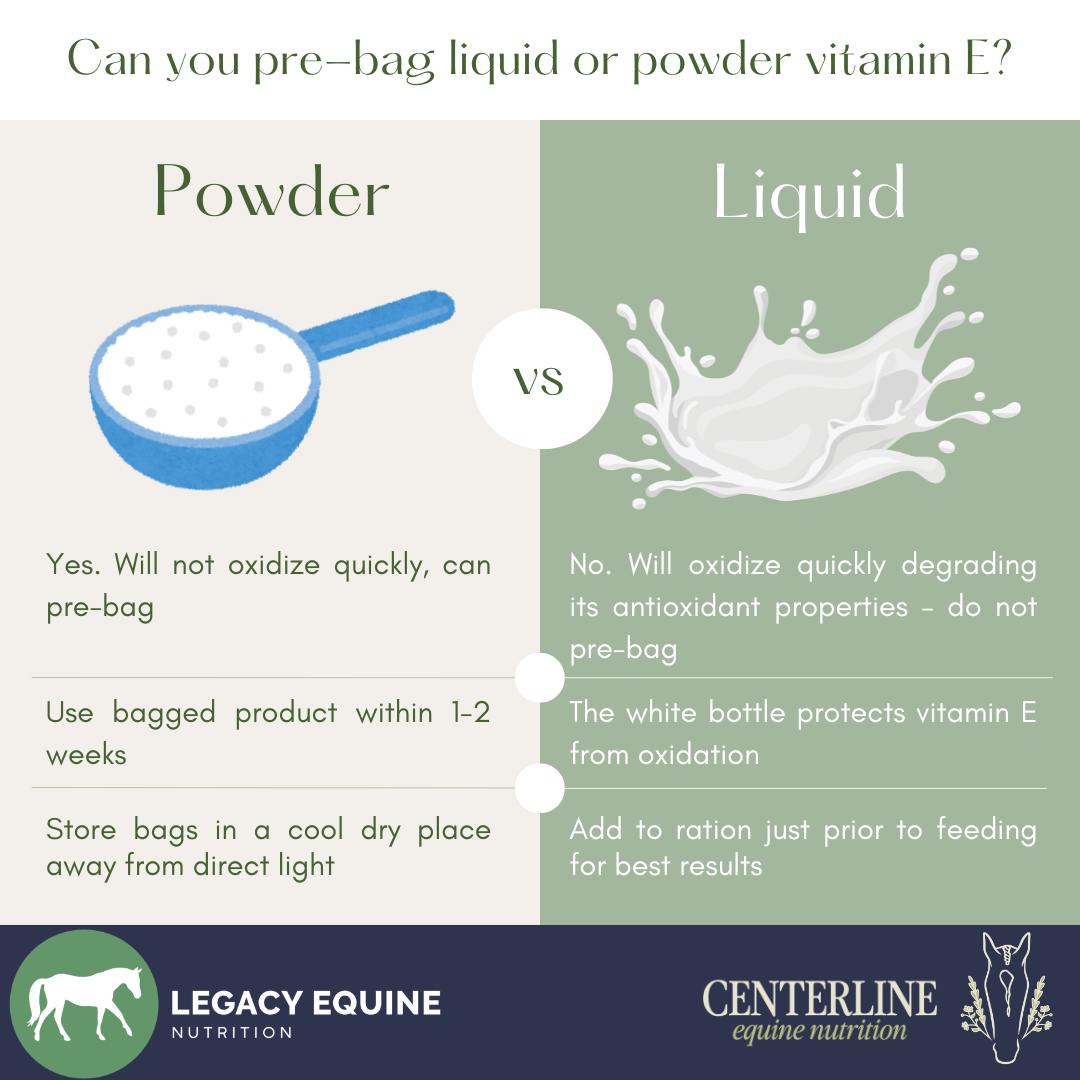
Can I prep small bags of vitamin E? The TL:DR version: liquid no, powder yes.
The opaque or white bottles of liquid vitamin E are doing a lot of work to protect the α-tocopherol from degradation (oxidation). Vitamin E is photoreactive, meaning light is a primary driver of oxidation so once you remove the liquid from the protective barrier, you are losing the protection and degradation accelerates meaningfully. Thus, it is not recommended to bag liquid vitamin E or store outside of the bottle for a prolonged period prior to feeding it.
Vitamin E powders are a different story. The ester form (tocopheryl acetate or succinate) has the protective cap on the reactive group and has a lower surface area exposure compared to the liquid, making it considerably more stable once bagged or prepped. From both a chemistry and practical standpoint prepping powdered vitamin E ahead of time is fine. Store in a cool, dry place away from light and use within a week or two post-bagging for best practice. There’s no peer-reviewed data on how quickly pre-bagged powder degrades, but the chemistry supports it being a reasonable practice.
Key takeaways:
Vitamin E is naturally reactive to protect the horse from oxidative stress
Vitamin E must be stabilized prior to adding it to a feed or supplement
Approximately 30-40% of stabilized vitamin E is lost in the pelleting process
The liver preferably takes up natural vitamin E for distribution to tissues
d-α-tocopheryl acetate/succinate on a label is natural vitamin E
dl-α-tocopheryl acetate/succinate on a label is synthetic vitamin E
Some feed companies add “vitamin E supplement” in the ingredients list and that most often indicates that the form is synthetic
Pre-bagging powdered vitamin E is ok to do, but do not let sit for more than two weeks
Do not bag liquid vitamin E, it is photoreactive and will degrade rapidly with air and light exposure
Most Read